
Brenda McKinley has been offering houses in Ontario for much more than two decades and even for a veteran, the past few of yrs have been surprising.
Rates in her patch south of Toronto rose as a great deal as 50 for every cent throughout the pandemic. “Houses had been advertising pretty much prior to we could get the sign on the garden,” she stated. “It was not strange to have 15 to 30 offers . . . there was a feeding frenzy.”
But in the previous 6 weeks the sector has flipped. McKinley estimates homes have get rid of 10 for each cent of their worth in the time it could possibly just take some potential buyers to total their invest in.
The phenomenon is not distinctive to Ontario nor the residential marketplace. As central banking institutions jack up curiosity charges to rein in runaway inflation, assets investors, house owners and business landlords close to the globe are all asking the exact same problem: could a crash be coming?
“There is a marked slowdown everywhere,” claimed Chris Brett, head of capital marketplaces for Europe, the Middle East and Africa at property agency CBRE. “The adjust in value of financial debt is getting a large effect on all marketplaces, across every little thing. I really don’t believe everything is immune . . . the velocity has taken us all by shock.”
Detailed home shares, intently monitored by traders hunting for clues about what could possibly ultimately happen to considerably less liquid genuine property, have tanked this 12 months. The Dow Jones US True Estate Index is down nearly 25 for every cent in the calendar year to date. British isles property shares are down about 20 for every cent in excess of the exact same period, slipping more and a lot quicker than their benchmark index.
The quantity of professional purchasers actively searching for assets across the US, Asia and Europe has fallen sharply from a pandemic peak of 3,395 in the fourth quarter of final calendar year to just 1,602 in the next quarter of 2022, according to MSCI facts.
Pending offers in Europe have also dwindled, with €12bn in contract at the end of March against €17bn a 12 months before, in accordance to MSCI.
Promotions currently in coach are staying renegotiated. “Everyone providing every little thing is getting [price] chipped by future customers, or else [buyers] are walking absent,” reported Ronald Dickerman, president of Madison Worldwide Realty, a private fairness company investing in residence. “Anyone underwriting [a building] is possessing to reappraise . . . I simply cannot about-emphasise the amount of repricing going on in actual estate at the moment.”
The cause is basic. An investor ready to fork out $100mn for a block of residences two or 3 months back could have taken a $60mn mortgage loan with borrowing expenses of about 3 for every cent. Now they could have to fork out additional than 5 per cent, wiping out any upside.
The transfer up in rates usually means traders ought to both settle for lower total returns or push the vendor to decrease the price.
“It’s not however coming by way of in the agent information but there is a correction coming by way of, anecdotally,” mentioned Justin Curlow, global head of research and method at Axa IM, just one of the world’s premier asset professionals.

The issue for assets traders and house owners is how widespread and deep any correction may be.
Through the pandemic, institutional investors played defence, betting on sectors supported by steady, very long-phrase demand. The price of warehouses, blocks of rental residences and workplaces geared up for lifestyle sciences enterprises duly soared amid fierce opposition.
“All the massive buyers are singing from the same hymn sheet: they all want residential, city logistics and higher-high quality workplaces defensive assets,” claimed Tom Leahy, MSCI’s head of serious property study in Europe, the Middle East and Asia. “That’s the difficulty with authentic estate, you get a herd mentality.”
With funds sloshing into tight corners of the home industry, there is a threat that property have been mispriced, leaving little margin to erode as rates rise.
For entrepreneurs of “defensive” attributes purchased at the leading of the current market who now need to refinance, amount rises generate the prospect of house owners “paying more on the loan than they hope to get paid on the property”, explained Lea Overby, head of commercial mortgage-backed securities investigate at Barclays.
Before the Federal Reserve started elevating fees this calendar year, Overby approximated, “Zero for each cent of the market” was affected by so-known as detrimental leverage. “We don’t know how considerably it is now, but anecdotally its fairly common.”
Manus Clancy, a senior handling director at New York-dependent CMBS data service provider Trepp, explained that whilst values had been not likely to crater in the a lot more defensive sectors, “there will be lots of guys who say ‘wow we overpaid for this’.”
“They assumed they could increase rents 10 per cent a year for 10 many years and expenses would be flat but the client is getting whacked with inflation and they just cannot move on expenses,” he added.
If investments regarded as guaranteed-hearth just a few months ago appear precarious riskier bets now search toxic.
A increase in ecommerce and the change to hybrid function in the course of the pandemic still left entrepreneurs of workplaces and retailers uncovered. Growing costs now threaten to topple them.
A paper released this thirty day period, “Work from property and the business true estate apocalypse”, argued that the whole price of New York’s workplaces would in the end slide by pretty much a third — a cataclysm for owners like pension funds and the federal government bodies reliant on their tax revenues.
“Our perspective is that the total business stock is value 30 for each cent a lot less than it was in 2019. That’s a $500bn strike,” reported Stijn Van Nieuwerburgh, a professor or true estate and finance at Columbia College and 1 of the report’s authors.
The decline has not however registered “because there’s a very big segment of the business market — 80-85 per cent — which is not publicly listed, is incredibly untransparent and where by there’s been extremely tiny trade”, he added.
But when more mature places of work transform hands, as cash occur to the stop of their life or entrepreneurs struggle to refinance, he expects the reductions to be significant. If values fall much ample, he foresees adequate home loan defaults to pose a systemic possibility.

“If your loan to value ratio is previously mentioned 70 for each cent and your price falls 30 per cent, your house loan is underwater,” he said. “A great deal of workplaces have a lot more than 30 for each cent mortgages.”
In accordance to Curlow, as significantly as 15 per cent is currently becoming knocked off the price of US workplaces in remaining bids. “In the US business office industry you have a better level of vacancy,” he reported, including that The us “is floor zero for prices — it all started off with the Fed”.
Uk office house owners are also getting to navigate transforming doing work designs and growing charges.
Landlords with contemporary, electricity-productive blocks have so significantly fared reasonably well. But rents on more mature structures have been strike. Assets consultancy Lambert Smith Hampton advised this 7 days that extra than 25mn sq ft of British isles office environment space could be surplus to necessities following a study discovered 72 for every cent of respondents have been hunting to cut back on office environment room at the earliest opportunity.
Hopes have also been dashed that retail, the sector most out of favour with traders coming into the pandemic, may possibly enjoy a restoration.
Massive United kingdom buyers including Landsec have wager on shopping centres in the earlier six months, hoping to capture rebounding trade as persons return to actual physical shops. But inflation has knocked the restoration off system.
“There was this hope that a large amount of procuring centre house owners experienced that there was a degree in rents,” claimed Mike Prew, analyst at Jefferies. “But the rug has been pulled out from under them by the price tag of residing disaster.”

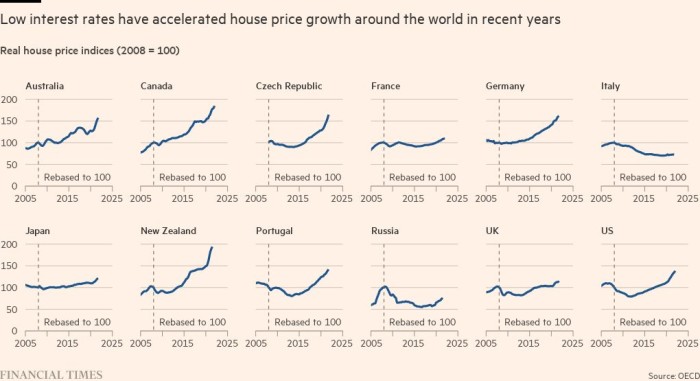
As costs rise from ultra-minimal ranges, so does the risk of a reversal in residential markets the place they have been rising, from Canada and the US to Germany and New Zealand. Oxford Economics now expects selling prices to drop next 12 months in individuals marketplaces wherever they rose fastest in 2021.
Quite a few investors, analysts, agents and house proprietors informed the Monetary Situations the risk of a downturn in property valuations experienced sharply elevated in current weeks.
But few expect a crash as critical as that of 2008, in portion since lending techniques and chance urge for food have moderated due to the fact then.
“In normal it feels like business genuine estate is established for a downturn. But we experienced some robust advancement in Covid so there is some area for it to go sideways just before impacting just about anything [in the wider economy],” reported Overby. “Pre-2008, leverage was at 80 per cent and a good deal of appraisals have been fake. We are not there by a very long shot.”
In accordance to the head of just one significant actual estate fund, “there’s absolutely tension in more compact pockets of the marketplace but which is not systemic. I really do not see a lot of persons saying . . . ‘I’ve committed to a €2bn-€3bn acquisition applying a bridge format’, as there were in 2007.”
He added that though much more than 20 businesses looked precarious in the operate-up to the economic disaster, this time there were being perhaps now 5.
Dickerman, the personal equity trader, thinks the financial state is poised for a extensive period of time of agony reminiscent of the 1970s that will idea genuine estate into a secular drop. But there will however be winning and losing bets for the reason that “there has hardly ever been a time investing in genuine estate when asset classes are so differentiated”.
About the Author


